Most people who commission a room integrity test think they are testing the FM200 system. They are not. The cylinders, nozzles and detection are tested by the installer and the fire alarm contractor. The door fan test measures the room — specifically, how much air leaks out of it — and uses that figure to predict whether a discharged clean agent will stay at the design concentration for as long as the standard requires. This article explains what is measured, how the result is calculated and why rooms fail, so that facility managers, contractors and consultants in Saudi Arabia know what they are looking at when the report arrives. For the service, see FM200 room integrity testing.
Why the room matters more than the cylinders
FM200 (HFC-227ea) and similar clean agents extinguish fire by holding a gas concentration in the protected enclosure — typically a server room, electrical room, archive or control room — for a set period. NFPA 2001 and ISO 14520 both require the concentration to be held for a minimum retention time, normally ten minutes, so that the fire does not re-ignite before the fire service or the building team responds. The agent is heavier than air, so it drains out through leaks low in the room while air enters through leaks higher up. Every unsealed cable penetration, gap under a door, unsealed duct or open cable tray shortens the time the room holds the gas. A perfect system in a leaky room fails.
What the door fan test measures
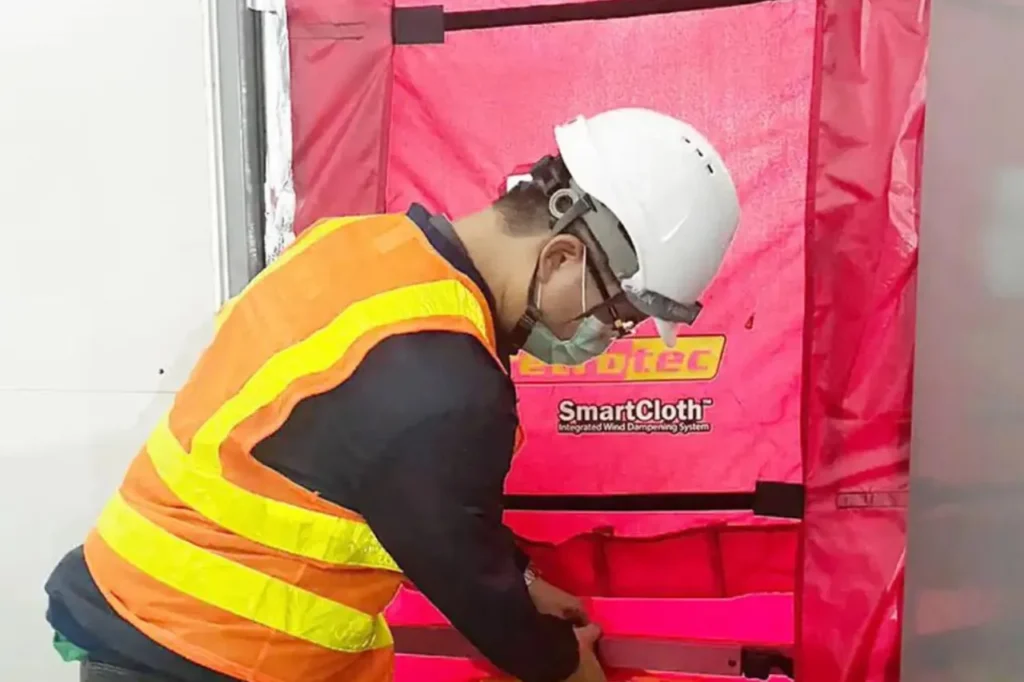
The test uses a calibrated fan mounted in a door frame, with the room otherwise closed. The fan pressurises the room to a series of pressures, then depressurises it, and at each pressure the airflow through the fan is measured. The relationship between pressure and flow gives the equivalent leakage area (ELA) — the size of a single hole that would leak the same amount as all the room’s leaks combined. That figure is entered, together with the room volume, ceiling height, agent, design concentration and the height of the protected equipment, into a retention calculation that predicts how long the agent concentration will stay above the minimum at the required height. The output is a pass or fail against the required retention time, plus the leakage figures themselves.
Two things follow from this. First, the test is non-destructive and does not discharge any agent — no cylinders are touched. Second, the result depends entirely on the room as it is on the day: a new cable penetration cut after the test invalidates the result, which is why the standards require re-testing after any change to the enclosure and at intervals afterwards.
How the numbers are read
- Equivalent leakage area: the total leak size in square metres or square centimetres. Lower is better. The report usually splits it into upper and lower leakage, which matters because agent drains through the lower leaks.
- Predicted retention time: how long the agent concentration stays above the minimum at the protected height. It must exceed the required time — ten minutes in most specifications.
- Peak pressure check: the discharge itself raises room pressure; the test also checks that the room’s leakage is enough to relieve that pressure without damaging walls or doors, which is why sealing every last leak is not the goal.
- Leak locations: a competent test includes smoke pencils or a thermal camera to locate the leaks, so the report tells the contractor where to seal, not just that the room failed.
Why rooms fail in practice
In our experience the failures are rarely exotic. Unsealed cable penetrations through walls and raised floors are the most common, followed by gaps under doors without drop seals, unsealed duct and pipe sleeves, open cable trays through the ceiling void, and doors that do not close properly. New builds fail because the firestop contractor has not finished; existing rooms fail because someone added a cable after the last test. A related failure is a false ceiling or raised floor that was not part of the protected volume in the design but is open to it in reality — the agent fills a larger space than the cylinders were sized for.
What an independent test adds
The installer of the suppression system has an interest in the room passing. An independent third party has an interest in the number being correct. Spectrum Elements for Consulting does not supply or install fire protection products — our role is to observe, measure and record. We carry out the door fan test with calibrated equipment, locate the leaks, record the leakage areas and the retention calculation, and issue the report in the format Saudi Civil Defence and the consultant expect. If the room fails, the report shows what to seal; we re-test after the sealing and issue the pass. See our firestop inspection service for the sealing verification that usually goes with it.
When to test
- At commissioning, before the system is handed over and before the Civil Defence inspection.
- After any change to the enclosure — new penetrations, doors, ducts, raised-floor works.
- Periodically thereafter; many specifications and insurers require annual testing.
- Before a fit-out of an adjacent space that shares walls, ceilings or floor voids with the protected room.
What to prepare
The room drawings with the protected volume marked, the design concentration and agent, the required retention time from the specification, access to the room with doors closable and HVAC isolated or switched to the state the design assumes, and someone from the contractor to seal minor leaks on the day if a quick re-test is wanted. Send those through the inspection request form and we will confirm the scope.
A worked example
A 180 m³ server room in Riyadh with a 3 m ceiling and equipment protected to 2.4 m was tested at commissioning. The first run found an equivalent leakage area dominated by lower leaks: an unsealed 150 mm sleeve under the raised floor and a door with no drop seal. Predicted retention time was under four minutes against the ten required. The contractor sealed the sleeve with a tested firestop system and fitted a door seal; the re-test the same afternoon found the lower leakage cut to a fraction and the predicted retention time comfortably above ten minutes. The report, with both test runs, photographs of the leaks and the sealing, and the retention calculation, went into the Civil Defence file. Nothing about the FM200 system itself changed — only the room.
Specification wording that avoids arguments
Most disputes over a failed room come from a specification that says only “room integrity test to NFPA 2001”. A clause that avoids the argument states: the standard and edition; the agent, design concentration and protected height; the required retention time; whether the test is pressurisation, depressurisation or both, and the pressures; the HVAC state during the test; that the test is carried out after all penetrations are sealed and doors fitted; that leak locations are to be identified and reported; and who witnesses. With those items in writing, the report passes or fails against a known target and the re-test after sealing is a formality rather than a negotiation.
Independent test versus installer test
The suppression contractor often offers a door fan test as part of commissioning, and that is a reasonable quality-control step. The difference with an independent test is who signs the retention calculation. When the installer signs, the consultant is asked to accept the installer’s statement that the installer’s room passes. When Spectrum Elements signs, the calculation, the leakage figures and the leak photographs come from a party with nothing to gain from the result — a distinction worth having on record in a Civil Defence file that may be reviewed years later.
Frequently asked questions
Does a door fan test discharge the FM200?
No. The test uses a calibrated fan to measure room leakage and predicts retention time by calculation. No agent is released and the cylinders are not touched.
What retention time is required?
Typically ten minutes at the design concentration and the protected height, as required by NFPA 2001 and ISO 14520 and as stated in the project specification.
How long does the test take?
Usually one to two hours per room including setup, pressurisation and depressurisation runs, leak location and a re-test if minor leaks are sealed on the day.
Why did the room fail when the system is new?
Because the test measures the room, not the system. Unsealed cable penetrations, gaps under doors, unsealed sleeves and open cable trays are the usual causes.
How often should the room be re-tested?
After any change to the enclosure and at the interval the specification or insurer requires — commonly annually.

Independent passive fire protection inspection and testing consultancy based in Riyadh. We do not supply or install fire protection products — our role is to observe, measure and record.
Request an inspection
Send the scope, location and any drawings. We review the scope, inspect on site, record every finding with photographs and measurements, and issue a report for Civil Defence and consultant approval.