Electrical fires rarely start without warning. A loose lug, a corroded contact, an overloaded phase or a breaker that no longer trips cleanly all run hot for weeks or months before they fail, and heat is visible to an infrared camera long before it is visible to anyone else. A thermography survey of switchboards, distribution boards, busbars and motor control centres is the cheapest predictive maintenance a facility can buy, and it is carried out with the system live and under load. This article explains what a Level II survey involves, how findings are classified and what the report gives a facility manager or QA/QC engineer. For the service, see thermography and infrared inspection.
What the camera sees
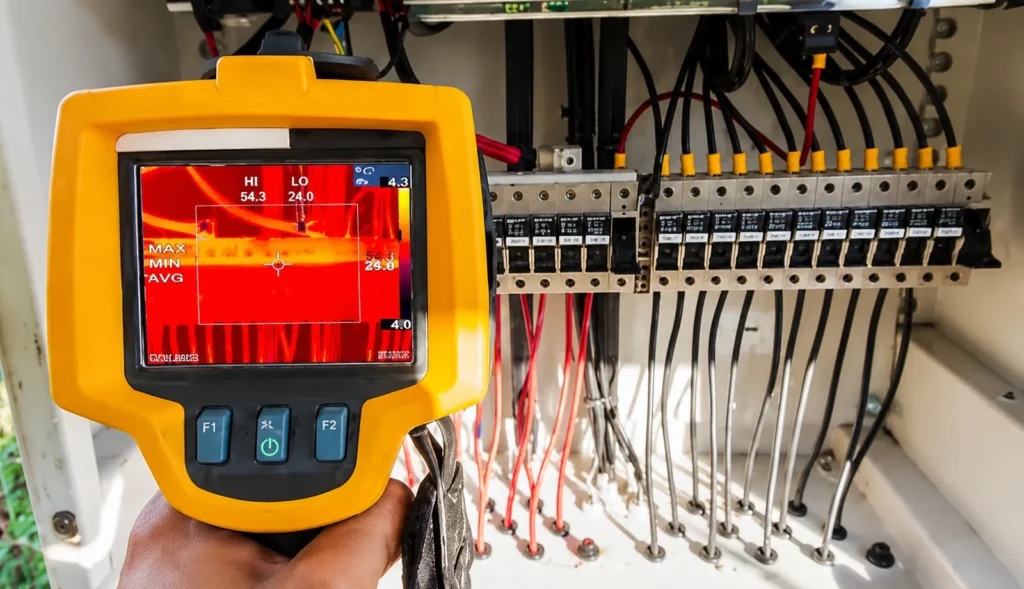
A radiometric infrared camera measures the surface temperature of everything in its field of view and produces a thermal image in which hotter surfaces are brighter. On an electrical panel, a healthy termination is at roughly the same temperature as its neighbours carrying the same current; a faulty one is hotter, sometimes by a few degrees, sometimes by more than a hundred. The camera does not see through covers, so the survey is done with panel covers removed by the facility’s electrician and the circuits loaded — ideally at or above 40% of rated load, because a fault carrying no current does not heat up.
What “Level II” means
Thermographer certification follows a three-level scheme. A Level I thermographer can operate the camera and collect images under supervision; a Level II thermographer can set up the survey, choose emissivity and reflected-temperature parameters, interpret the images, quantify the temperature rise and write the report; Level III can develop procedures and train. The difference matters on electrical work because the raw temperature on the screen is not the finding — the finding is the temperature difference against a reference component under the same load, corrected for the surface’s emissivity, with the severity classified. Our surveys are carried out by Level II certified thermographers using FLIR radiometric cameras, and the certification and camera details are recorded in the report.
What a survey finds
- Loose or corroded terminations — the single most common finding: one lug on a three-phase breaker hotter than the other two.
- Phase imbalance and overload — one phase conductor consistently hotter along its length.
- Failing breakers and contactors — heat at the contact rather than at the terminal.
- Undersized or damaged conductors — a cable hotter than its neighbours carrying similar current.
- Busbar joints — hot bolted joints inside switchgear and rising mains.
- Harmonic heating in neutrals and transformers.
- Blocked ventilation — whole enclosures running hot.
How findings are classified
Findings are ranked by the temperature rise above a reference — usually the same component on another phase, or ambient — and by the load at the time. A common scheme is: advisory (small rise, monitor at next survey), intermediate (repair at the next planned shutdown), serious (repair as soon as possible) and critical (immediate action, risk of failure). The thresholds come from the client’s standard or a recognised guideline, and they are stated in the report. Each finding is reported with a thermal image, a visual image of the same component, the measured temperatures, the load at the time, the classification and the recommended action.
Why it matters for fire protection
Passive fire protection — firestop, fireproofing, compartmentation — limits the spread of a fire that has started. Thermography reduces the number of fires that start. For a facility manager preparing for a Civil Defence inspection or an insurer’s survey, a current thermography report on the main electrical installation is evidence of an active maintenance regime, and the corrective actions it lists are the cheapest fire prevention available: a torqued lug, a replaced breaker, a rebalanced phase.
How a survey is run
- Scope: the panels, switchgear, busbars and motor control centres to be surveyed, with single-line diagrams where available.
- Load: the survey is scheduled for a period of representative load; no-load surveys are noted as such.
- Access: the facility’s electrician removes covers under the site’s safety procedures; the thermographer never opens panels.
- Imaging: every panel is imaged systematically, with visual images for reference and load readings recorded.
- Analysis: temperatures corrected for emissivity and reflected temperature, findings classified.
- Report: findings by panel with images, classification and recommended action; a summary for management; a register for the next survey.
Beyond electrical panels
The same camera surveys mechanical plant (bearings, motors, couplings), steam and hot-water systems, refrigeration, and building envelopes — missing insulation, air leakage paths and moisture behind finishes. On fire protection projects thermography also locates leaks during FM200 room integrity testing and traces water ingress in water leakage inspection. A combined survey is often the most economical way to cover a facility.
Frequency
Annual surveys are the norm for commercial buildings; six-monthly or quarterly for data centres, industrial plants and critical switchgear; and a survey after any major electrical alteration or after a panel has been worked on. Trending findings survey to survey is where the value builds — a termination that is warmer each year is telling you something.
What to provide
The list of panels and their locations, single-line diagrams if available, the site’s permit-to-work procedure, an electrician to remove covers, and a time when the installation is under load. Send those through the inspection request form and we will schedule the survey.
A worked example: a district cooling plant switchboard
An annual survey of the main switchboard and motor control centres was carried out at afternoon load, with the plant electrician removing covers under permit. Of the several hundred terminations imaged, most were within a degree or two of their neighbours. Three findings were classified above advisory: a chiller feeder with one phase lug well above the other two, classified serious and torqued the same day; a capacitor bank contactor with heat at the contact rather than the terminal, classified intermediate and replaced at the next shutdown; and a busbar joint in the rising main showing a moderate rise that had grown since the previous year’s survey, classified intermediate with a note to re-inspect after tightening. None of the three had tripped anything or shown any external sign. The report carried thermal and visual images of each, the load at the time, the temperature rise and the action, and the register was updated for next year’s comparison.
What to ask for in a thermography proposal
- Thermographer certification level (Level II for electrical work) and the camera model.
- Load conditions the survey will be carried out under, and how no-load panels will be treated.
- The classification scheme and thresholds.
- Report format: thermal and visual image per finding, temperatures, load, classification, action, and a register for trending.
- Confirmation that the thermographer does not open live equipment and that the facility provides the electrician.
Frequently asked questions
Does the building have to be shut down?
No. Thermography is carried out with the installation live and under load; a fault carrying no current does not heat up, so a loaded survey is what finds problems.
Who removes the panel covers?
The facility’s own electrician, under the site permit-to-work procedure. The thermographer images the panel and never opens live equipment.
What does Level II certification mean?
A Level II thermographer can set up the survey, correct for emissivity and reflected temperature, interpret the images, quantify temperature rises and write the report — the level required for meaningful electrical surveys.
How are findings ranked?
By the temperature rise above a reference component under the same load, classified as advisory, intermediate, serious or critical, with a recommended action for each.
How often should panels be surveyed?
Annually for most commercial buildings; more often for data centres, industrial plants and critical switchgear, and after any major electrical work.

Independent passive fire protection inspection and testing consultancy based in Riyadh. We do not supply or install fire protection products — our role is to observe, measure and record.
Request an inspection
Send the scope, location and any drawings. We review the scope, inspect on site, record every finding with photographs and measurements, and issue a report for Civil Defence and consultant approval.