“Smoke test” and “air leakage test” are often written in the same specification clause as if they were interchangeable, and then argued about on site when the results look different. They answer different questions. A smoke test shows you where air moves — through which gaps, in which direction. An air leakage test tells you how much air moves through the whole envelope, duct or component at a defined pressure. This article sets out what each one does, when each is the right specification, and how to combine them so that the report is useful. For the services, see smoke testing and air leakage testing.
Smoke testing: qualitative
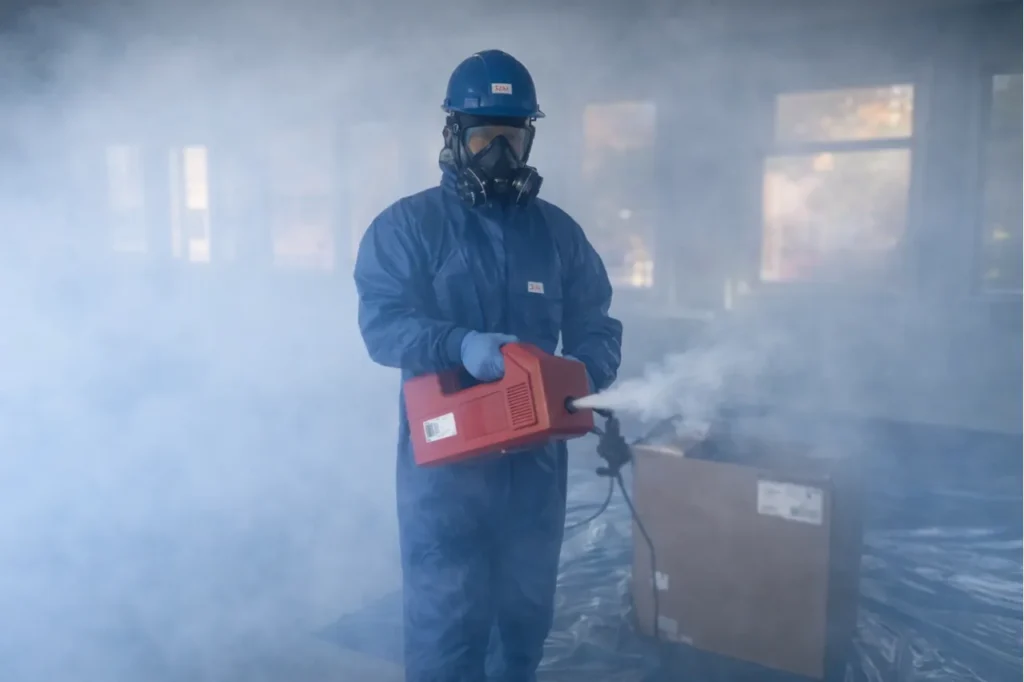
Non-toxic theatrical smoke is introduced into a space, a duct, a shaft or a compartment, usually with the space slightly pressurised, and the inspector watches where it appears on the other side. It is fast, visual and persuasive: a photograph of smoke streaming from a gap under a fire door or out of an unsealed sleeve above a ceiling settles arguments that a number never will. Typical uses:
- Verifying that a fire compartment or a protected corridor is actually sealed — the smoke should stay on its side.
- Proving smoke extract and stair pressurisation systems move air the way the design says, and finding short circuits.
- Locating leaks in ductwork and shafts before or after a quantitative test.
- Tracing leakage paths in car parks, atria and plant rooms during commissioning.
- Drainage and sewer testing (a different discipline with the same principle).
What a smoke test does not give is a number. It cannot tell you whether the envelope meets an air permeability limit or whether a duct meets its leakage class.
Air leakage testing: quantitative
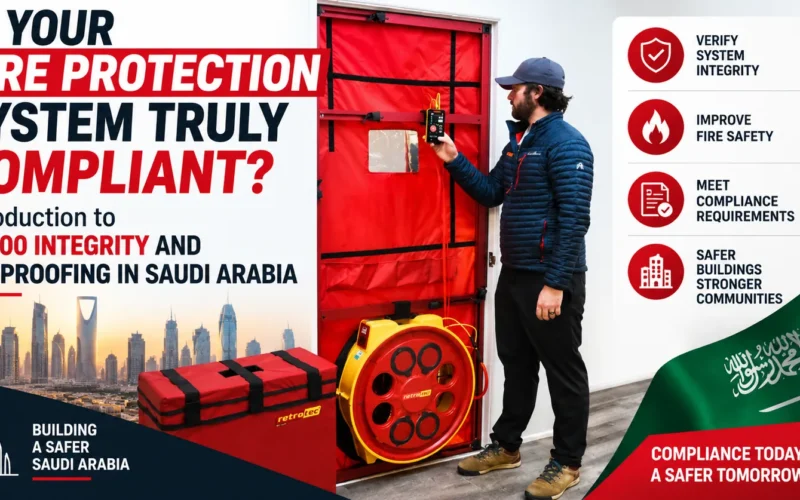
Air leakage testing pressurises the element under test with a calibrated fan and measures the airflow needed to hold a defined pressure difference. The result is a leakage rate that is compared with a specified limit. The family includes:
- Enclosure and envelope tests with a blower door — rooms, data halls, clean rooms, whole buildings — reported as air permeability, air changes per hour or equivalent leakage area. See air tightness testing.
- Duct leakage tests to SMACNA and ASHRAE 90.1 leakage classes. See the duct leakage commissioning guide.
- Component tests — windows, doors and curtain wall units tested to ASTM E283 (air) and E330 (structural / water) in a chamber or on site.
- Clean-agent enclosure tests — the FM200 door fan test, which adds a retention calculation.
What a quantitative test does not do well on its own is tell you where the leak is. The number says the room fails; the smoke says why.
Side by side
| Question | Smoke test | Air leakage test |
|---|---|---|
| What does it answer? | Where does air move, and in which direction? | How much air leaks at a defined pressure? |
| Output | Observations and photographs | Leakage rate vs a specified limit; pass/fail |
| Equipment | Smoke generator, sometimes a fan | Calibrated fan, flow meter, pressure gauges |
| Standards | Project specification; system commissioning procedures | ASTM E779 / E1827 / E283 / E330, SMACNA, ASHRAE 90.1, NFPA 2001 / ISO 14520 |
| Compliance evidence | Supporting | Primary |
| Best used | Finding and proving leak paths; system function checks | Acceptance testing of envelopes, ducts, components and enclosures |
Which one does your project need?
A data hall, clean room or protected enclosure: a quantitative air tightness test for compliance, with smoke or a thermal camera during the test to locate leaks. If a clean-agent system is installed, the door fan test with retention calculation is mandatory.
A duct system: a quantitative duct leakage test to the specified leakage class; smoke to find leaks in sections that fail.
Fire compartmentation and pressurised stairs: a smoke test proves the compartment holds and the pressurisation system works; a pressure-differential measurement across doors (a quantitative reading, but not a leakage test) confirms the cascade. Firestop and door seals found leaking are then inspected. See firestop inspection.
Façade, windows and doors: component air and water leakage tests to ASTM E283 and E330, on a sample; smoke rarely adds anything.
A commissioning report that has to satisfy a consultant: the quantitative test is the contractual evidence; the smoke test is the photograph that shows what was fixed.
Writing the specification clause
- Name the test method standard and the element to be tested.
- State the pressure and the acceptance limit (leakage class, permeability, retention time).
- State the extent — 100% or a sample percentage, and the rule if a sample fails.
- State when in the programme the test happens and who witnesses.
- Say whether a smoke test is required to locate leaks after a failed quantitative test — it usually should be.
Independence
Both tests are commonly carried out by the installing contractor as self-certification. For acceptance the consultant and owner need an independent test with calibrated equipment and a report they can rely on. Spectrum Elements for Consulting does not install ductwork, envelopes or fire protection systems; we test, observe, measure and record. Send the specification clause and drawings through the inspection request form and we will confirm which tests answer your question.
A worked example: a pressurised escape stair
A stair pressurisation system on a hotel tower kept failing its pressure-differential check at the lobby doors on two floors. The quantitative reading — the pressure across the door — said the system was underperforming; it did not say why. A smoke test with the stair pressurised showed smoke pouring into the ceiling void above the lobby on those two floors through unsealed duct penetrations in the stair wall, and out through an unlatched riser door. The firestop was completed, the door repaired, and the differential readings came into range across all floors. The final commissioning report carried both: the differential pressures per floor as the compliance record, and the smoke photographs as the explanation. Neither test alone would have closed the item.
Choosing the right question
Before specifying a test, write down the question it has to answer. “Does this room hold FM200 for ten minutes?” is a quantitative question and needs the door fan test. “Is smoke getting from the car park into the lift lobby?” is a qualitative question and a smoke test answers it directly. “Does this duct meet Leakage Class 6?” is quantitative. “Why does it not?” is qualitative. Specify both where both questions exist, and put the quantitative one in the acceptance criteria.
What to send us
The specification clause, the drawings of the element to be tested (room, duct run, stair, compartment), the acceptance limit and the date the element will be complete. We reply with the test method, the equipment, the people we need on site, the conditions required on the day and the report format, so that the test answers the question the consultant is going to ask.
Frequently asked questions
Can a smoke test replace an air leakage test?
No. A smoke test shows where air moves; an air leakage test measures how much. Compliance limits are quantitative, so acceptance needs the leakage test; smoke locates the leaks.
Is the smoke harmful?
Non-toxic theatrical smoke is used. It is safe for occupied buildings with the usual precautions and does not stain finishes.
Which standards cover air leakage testing?
ASTM E779 and E1827 for enclosures, ASTM E283 and E330 for components, SMACNA and ASHRAE 90.1 for ducts, and NFPA 2001 / ISO 14520 for clean-agent enclosures.
Do I need both on a data centre?
Usually yes: a quantitative air tightness or door fan test for compliance and retention, with smoke or a thermal camera to find the leak paths to seal.
Who should carry out the tests?
An independent third party with calibrated equipment for acceptance testing; the installer’s own test is a quality-control step, not the compliance record.

Independent passive fire protection inspection and testing consultancy based in Riyadh. We do not supply or install fire protection products — our role is to observe, measure and record.
Request an inspection
Send the scope, location and any drawings. We review the scope, inspect on site, record every finding with photographs and measurements, and issue a report for Civil Defence and consultant approval.