A facility manager in Riyadh recently discovered his server room would have failed a real fire event — not because the FM200 system was faulty, but because a contractor had cut a new cable penetration through the wall six months earlier and never sealed it. The gas would have drained out of the room in under a minute.
The system was installed. The certificate was on file. The room was not protected.
This gap between “installed” and “actually working” is the single most common fire protection problem across Saudi facilities, and it is exactly what integrity testing and fireproofing inspection are designed to catch.
What Does FM200 Compliance Actually Mean?
It only works if the gas stays in the room long enough to do its job — typically a minimum hold time measured after discharge.
That means compliance is not about the cylinders. It is about the enclosure.
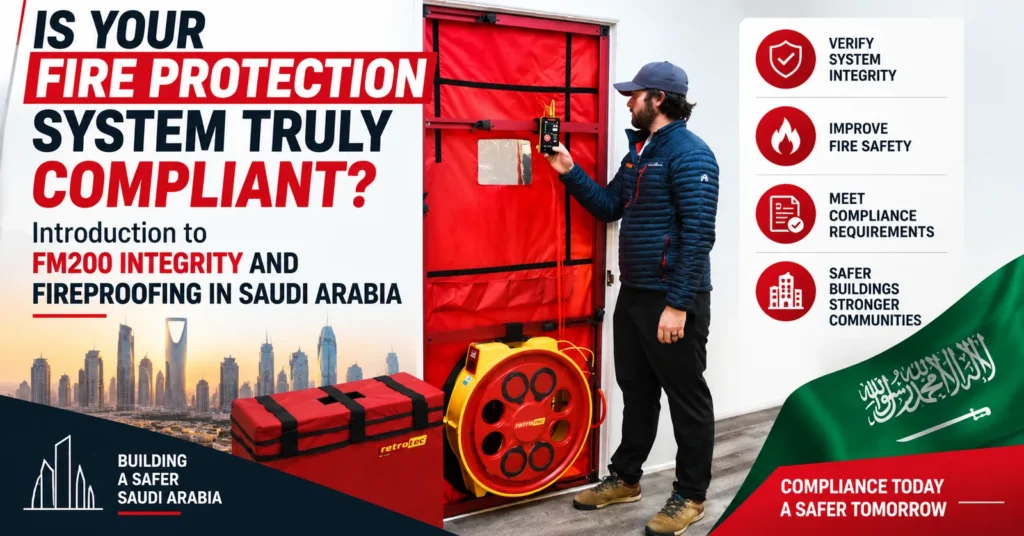
FM200 integrity services in Saudi Arabia use a door fan test to pressurise the room and measure how much air leaks out through gaps, cable trays, false ceilings, and door seals. From that leakage rate, engineers calculate the predicted agent retention time in line with NFPA 2001 requirements. If the room cannot hold the agent for the required period, the system fails — regardless of how new it is.
Why Rooms Fail Even When Nothing Looks Wrong
Most enclosures do not fail because of one large hole. They fail because of accumulated small changes:
- New data or power cables pulled through an existing sleeve without re-sealing
- Damper or duct modifications during an HVAC upgrade
- Door sweeps and gaskets worn down by daily traffic
- Raised floor voids or ceiling plenums that were never included in the original sealed volume
- Wall penetrations sealed with ordinary foam or silicone rather than a rated firestop system
None of these appear on a maintenance checklist. All of them change the leakage area of the room.
Where Fireproofing Fits Into the Same Picture
Suppression protects the contents. Fireproofing protects the structure — and the two are usually inspected together because they fail for similar reasons.
A fireproofing company or inspection body will typically verify:
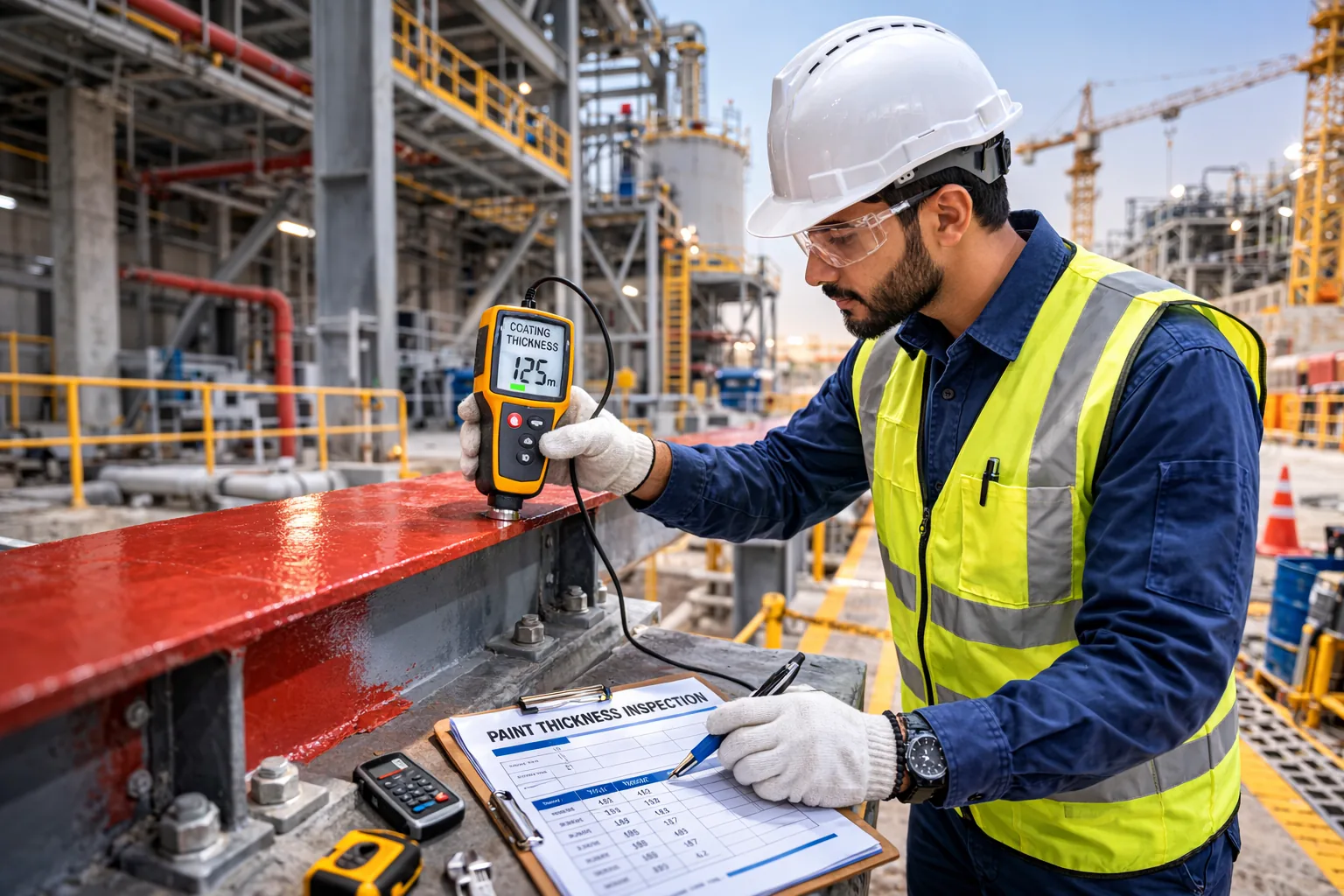
- Intumescent coatings on steel — checking dry film thickness against the specified fire rating and testing adhesion
- Spray-applied fire resistive material (SFRM) — checking density, thickness, and damage from subsequent trades
- Board and enclosure systems — checking joints, fixings, and continuity
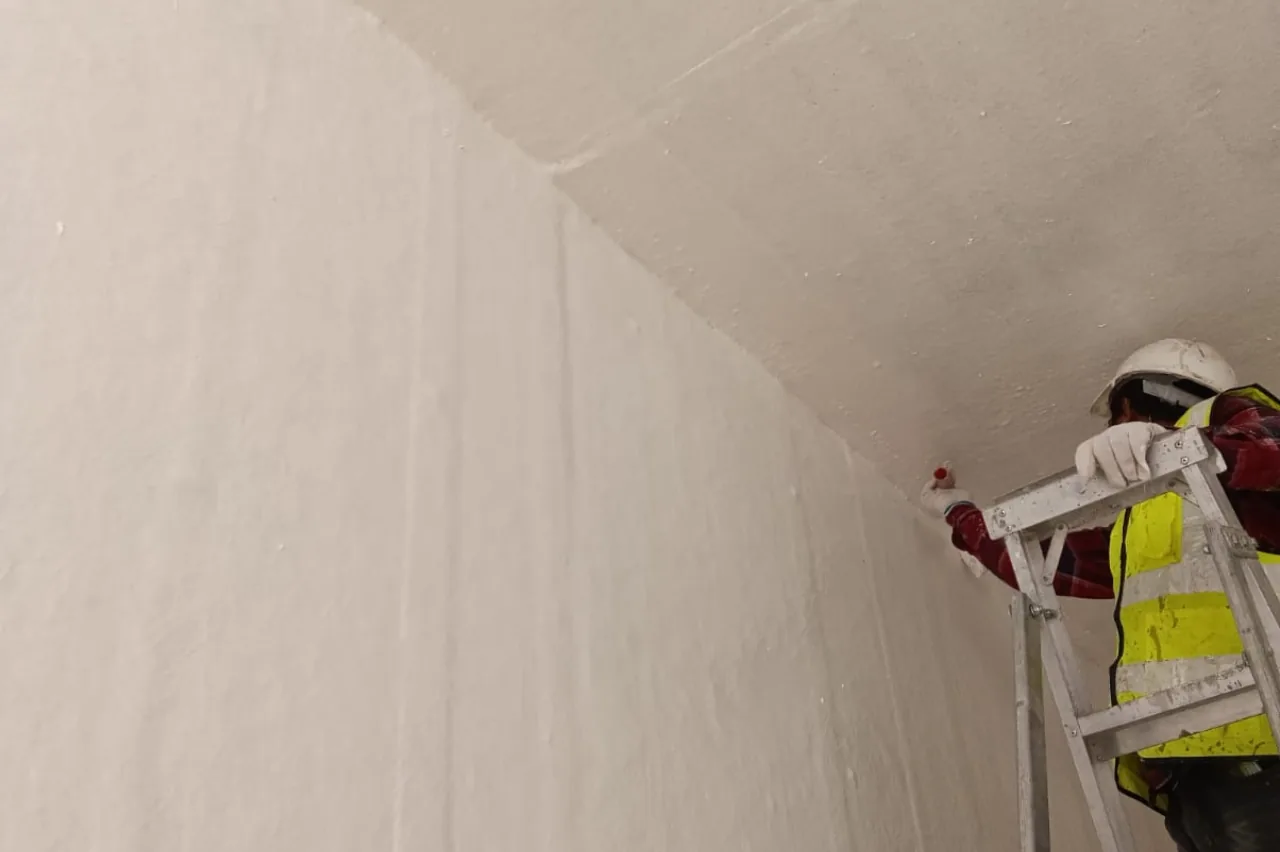
- Cable coating — verifying that fire-retardant coating on cable trays and bundles has been applied at the correct thickness and has not been breached by later cable pulls
- Firestop seals at every penetration through rated walls and floors
The most frequent finding is not missing material. It is material that was correctly applied and then damaged, drilled through, or over-loaded by a follow-on contractor.
What Should You Check Before Choosing an Inspection Provider?
Five questions worth asking:
- Is the testing method documented? Door fan testing should reference a recognised standard, not an informal walkthrough.
- Will you receive measured data? A useful report contains leakage area, calculated hold time, and DFT readings — not just a pass/fail statement.
- Is photographic evidence included? Defects should be located, photographed, and described clearly enough for a contractor to act on.
- Does the report include corrective guidance? Identifying a failure is only half the work.
- Is the provider familiar with Saudi Civil Defense expectations? Local acceptance matters as much as international standards.
When Should Testing Be Repeated?
Reasonable triggers include: after any construction or fit-out work in the protected space, after cabling or HVAC modification, following a system upgrade or relocation, and on a periodic cycle agreed with your insurer or authority having jurisdiction.
If your building has changed since the last test, the last test no longer describes your building.
Key Takeaways
- FM200 protection services depend on enclosure integrity, not cylinder capacity
- Small, undocumented site modifications are the leading cause of failed integrity tests
- Fireproofing and cable coating require thickness verification, not visual confirmation
- Documentation with measured data is what makes compliance defensible
- Re-testing after any building change is more valuable than a fixed annual date
Moving From Assumed Compliance to Verified Compliance
Most facilities are not deliberately non-compliant. They are simply working from documentation that describes the building as it was, not as it is. Every cable pull, every partition change, every ceiling access quietly moves the building away from its certified condition.
Independent FM200 integrity testing and fireproofing inspection close that gap with measured evidence.
If your enclosure has been modified since its last test — or you cannot confirm when it was last tested — a documented integrity and fireproofing inspection is the practical next step. Request an inspection quote to have your protected spaces assessed and reported against the standards your authority and insurer expect.
Frequently Asked Questions
What is an FM200 room integrity test?
A door fan pressurisation test that measures air leakage from a protected enclosure and calculates how long the clean agent will remain at effective concentration.
How long does the test take?
For a typical server or telecom room, the on-site testing is usually completed within a few hours. Larger or multi-zone enclosures take longer.
Does the room need to be emptied?
No. Testing is non-destructive and does not require the agent to be discharged, so operations are normally unaffected.
What happens if the room fails?
The report identifies the leakage sources so they can be sealed — usually cable penetrations, door seals, or ceiling voids — and the room is retested.
Is fireproofing inspection required if the material is already installed?
Yes. Installation and compliance are different things. Thickness and adhesion determine whether the rating is genuinely achieved.
Does cable coating need separate inspection?
It is normally covered within a fireproofing inspection scope, with thickness checks and verification that later cable installations have not breached the coating.
Who accepts these reports in Saudi Arabia?
Reports are generally prepared to align with Saudi Civil Defense expectations and NFPA methodology, and are used for authority submission, insurer requirements, and handover documentation.

Independent passive fire protection inspection and testing consultancy based in Riyadh. We do not supply or install fire protection products — our role is to observe, measure and record.
Request an inspection
Send the scope, location and any drawings. We review the scope, inspect on site, record every finding with photographs and measurements, and issue a report for Civil Defence and consultant approval.