Unprotected structural steel begins losing strength long before it melts. At around 550°C — a temperature a compartment fire can reach within minutes — steel retains roughly half its load-bearing capacity. That is the moment a beam stops being structured and starts being a hazard.
Fireproofing exists to delay that moment. But on most sites, nobody actually verifies that it will.
The coating gets applied, the invoice gets paid, the ceiling goes in, and the steel disappears behind it. Whether the material was thick enough, bonded properly, or survived the next three trades is rarely checked — and by handover, it is no longer visible.
What Fireproofing Inspection Actually Verifies
A fireproofing inspection in Saudi Arabia is not a visual walkthrough. It is a measurement exercise, and it usually covers three things.
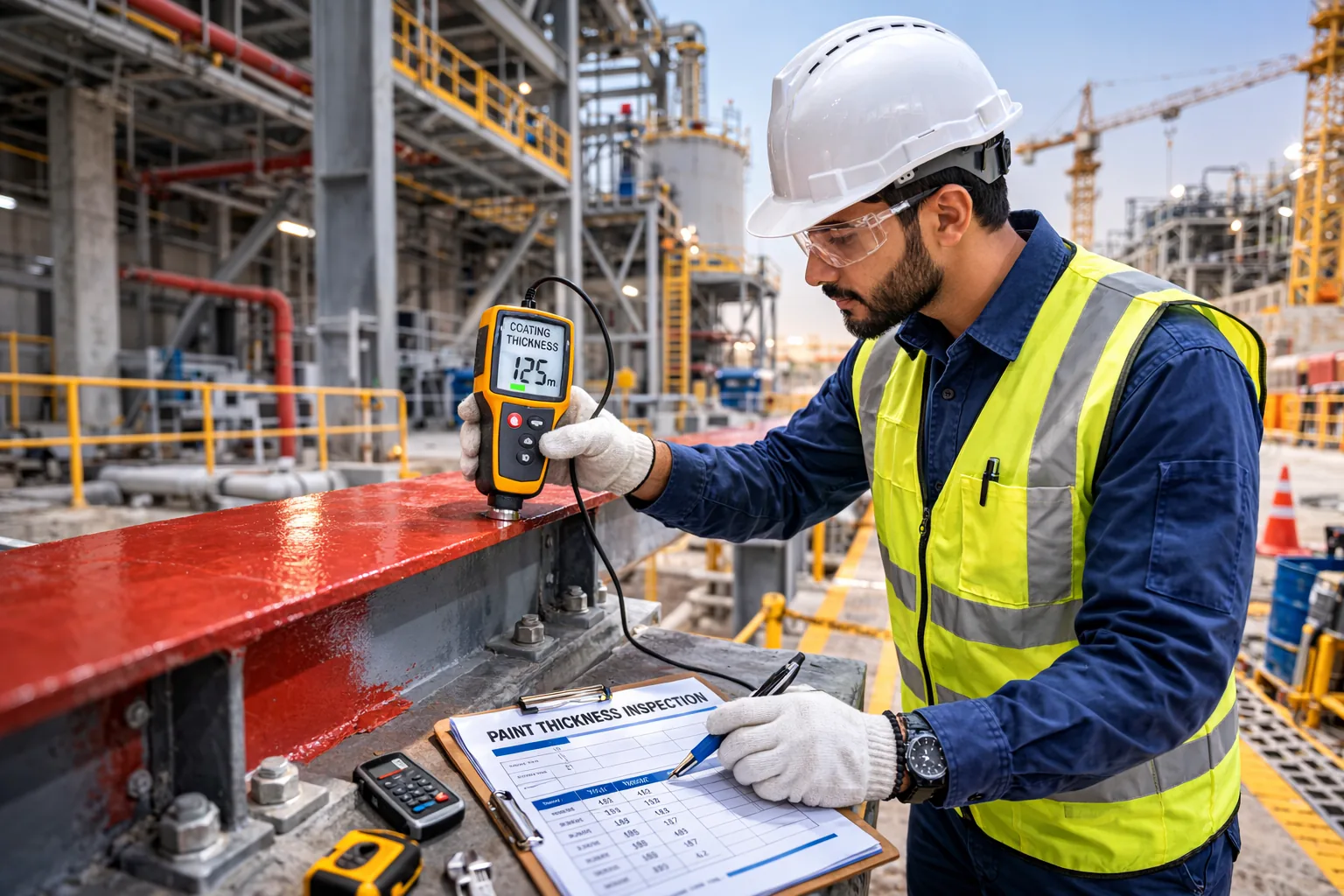
Thickness. Every fire rating — 60, 90, 120 minutes — corresponds to a specified dry film thickness for that section profile. Inspectors take DFT readings across the member and compare them against the approved specification. Thin patches are the most common non-conformance found on site.
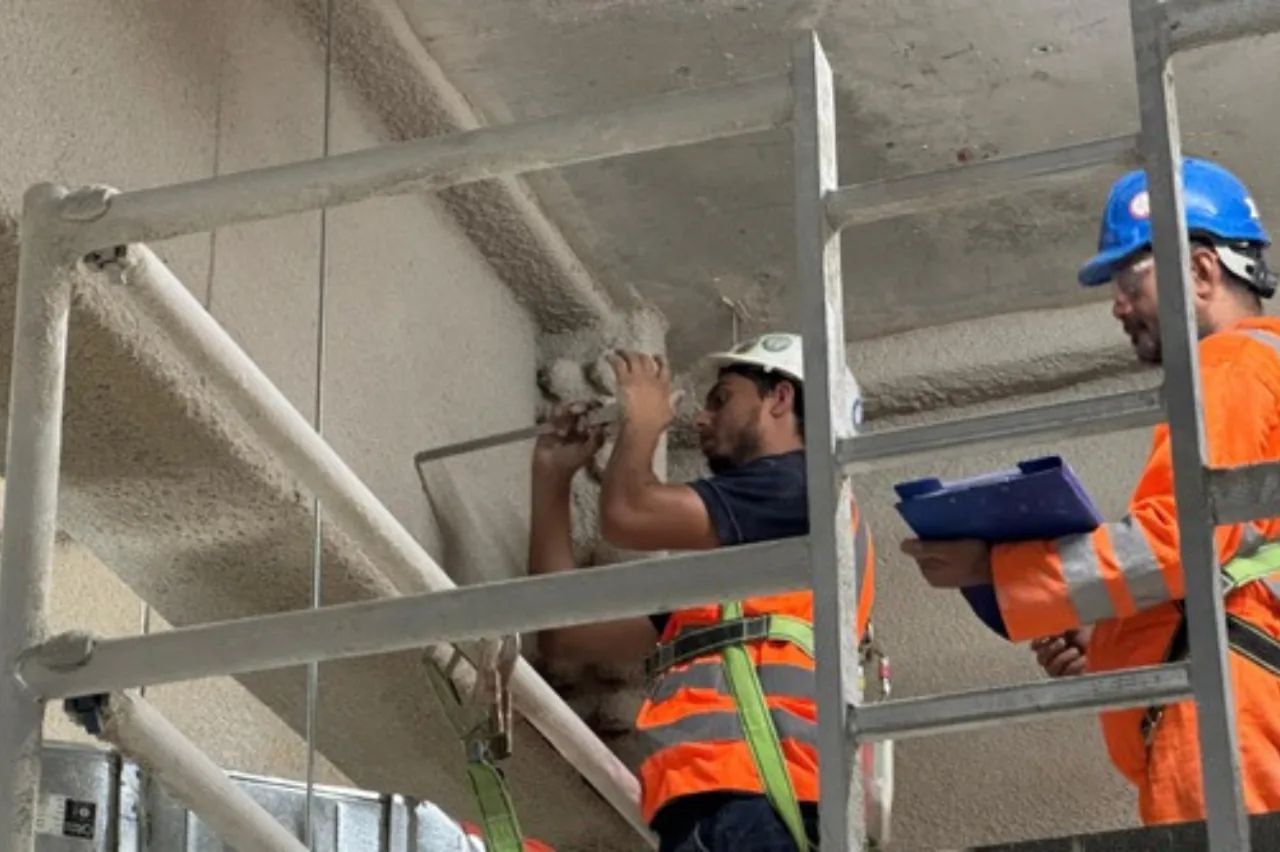
Adhesion. Coating that is the correct thickness but poorly bonded will detach under fire conditions. Adhesion testing confirms the material is actually holding to the substrate.
Substrate and application condition. Rust, mill scale, oil, incompatible primers, or application outside the manufacturer’s temperature and humidity window all compromise performance. In Saudi conditions, summer application temperatures are a genuine and frequently overlooked variable.
Why Correctly Installed Fireproofing Still Fails
Most defects are not created by the fireproofing contractor. They are created afterwards.
- MEP contractors drilling through coated steel to hang supports
- Cable trays and brackets bolted directly onto protected members
- Coating knocked off during scaffolding removal or material handling
- Overspray, plaster, or paint applied over intumescent coating, restricting how it expands
- Sections behind ceilings and risers left uncoated because they were assumed to be out of scope
A single 200mm bare patch on a load-bearing column is enough to make the rating for that member meaningless. This is why inspection timing matters as much as inspection itself.
Intumescent vs Cementitious: What Gets Checked Differently
Intumescent coatings are thin-film and expand into an insulating char when heated. They are used where steel remains visible. Inspection focuses heavily on DFT accuracy, since tolerances are tight, and on whether any topcoat or contamination could restrict expansion.
Cementitious and spray-applied fire resistive materials (SFRM) are thicker and typically concealed. Inspection focuses on thickness, density, bond strength, and physical damage from subsequent trades.
Both are commonly inspected alongside cable coating — fire-retardant coating on cable trays and bundles — where the same failure pattern applies: correct initial application, later cables pulled through, coating breached, nobody records it.
What Should You Check Before Choosing a Fireproofing Company or Inspector?
- Does the inspection produce measured data? Reports should contain DFT readings by member, not a general statement of compliance.
- Is inspection scheduled before concealment? Once ceilings, cladding, and risers close, verification becomes destructive and expensive.
- Is photographic evidence tied to locations? A defect that cannot be located cannot be corrected.
- Does the report include corrective guidance? Identifying a shortfall is only useful if the remedy is clear.
- Is the inspector independent of the applicator? Verification carries more weight when it is not self-certified.
When Should Steel Be Inspected?
Practical trigger points: after surface preparation and before coating begins, during application while access is still available, after application and before any concealment work, and again after MEP and fit-out trades have completed their installations.
That final check is the one most projects skip — and the one that catches the most defects.
Key Takeaways
- Fireproofing is a measured system, not a visual finish
- Dry film thickness and adhesion determine whether the fire rating is genuinely achieved
- Most damage occurs after application, caused by follow-on trades
- Cable coating and firestop penetrations fail for the same reason and should be verified together
- Inspection before concealment costs a fraction of inspection after it
Contact us to know more : +966 570 504 930, +966 56 628 8013
Frequently Asked Questions
What is a fireproofing inspection?
Verification that applied fire protection material meets its specified thickness, adhesion, and condition requirements so the structural member achieves its intended fire resistance rating.
How is thickness measured?
Using calibrated gauges taking multiple readings across each member, then comparing the averaged and minimum values against the approved specification for that section.
Is inspection required if the applicator provided a certificate?
An applicator certificate confirms what was applied. Independent inspection confirms what is actually present on the steel now, after all other trades have finished.
Can fireproofing be inspected after ceilings are installed?
Partially, through access panels and openings, but coverage is limited. Full verification usually requires access before concealment.
What happens if a section fails?
The affected areas are identified and recorded so the applicator can re-coat to specification, followed by re-inspection of those members.

Independent passive fire protection inspection and testing consultancy based in Riyadh. We do not supply or install fire protection products — our role is to observe, measure and record.
Request an inspection
Send the scope, location and any drawings. We review the scope, inspect on site, record every finding with photographs and measurements, and issue a report for Civil Defence and consultant approval.