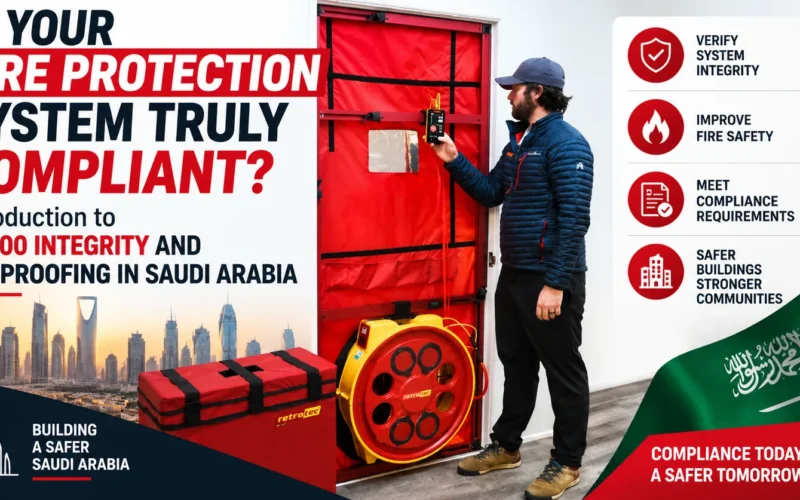
Most firestop snag lists look overwhelming. Six hundred items across twelve floors reads like a failed installation.
Read them closely, though, and the six hundred items usually collapse into a handful of repeating mistakes. The same error, made by the same crew, on every floor.
That is useful news. It means most defects are predictable — and a predictable defect can be prevented before the inspector ever arrives. Below are the seven that appear most often, what each one looks like on site, and what correcting it involves.
What Does a Firestop Inspection Actually Check?
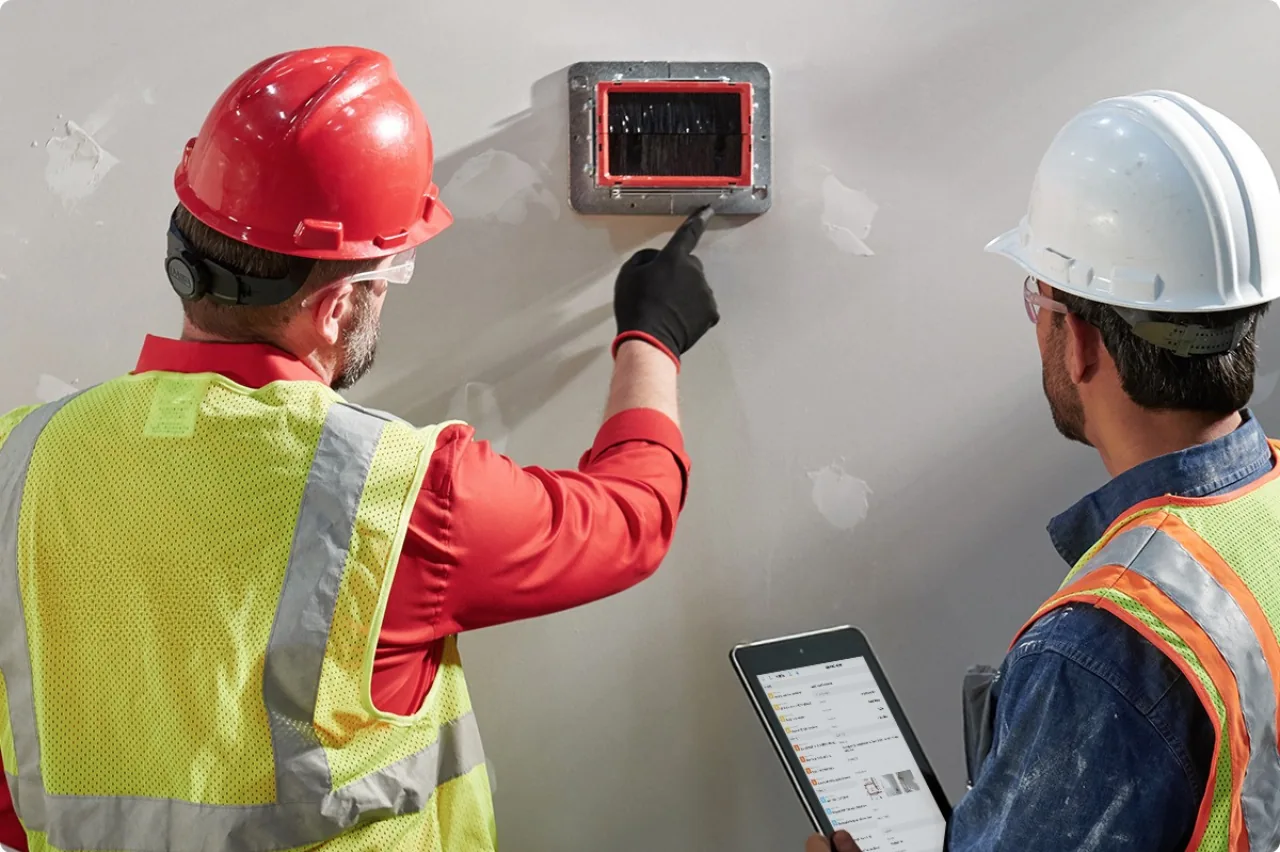
Compartmentation only works if every opening through a fire-rated wall or floor is closed with a system that has been tested for that exact situation. An inspection confirms each penetration seal and joint matches a listed system — the tested combination of substrate, service, opening size, and materials — and that it has been installed to that listing.
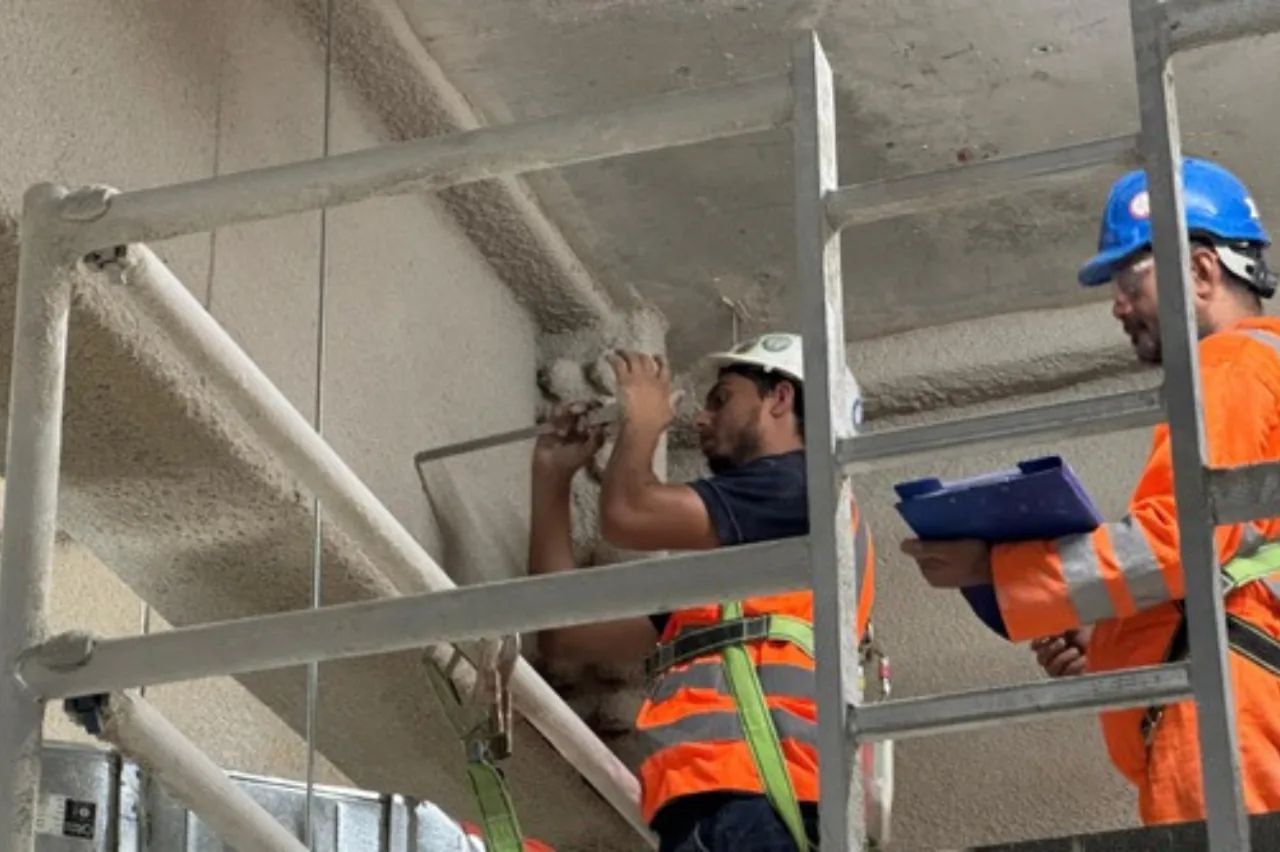
Firestop inspection services in Saudi Arabia typically combine visual checks, measurement, and limited destructive sampling, where a small number of seals are cut open to confirm depth and backing material that cannot be seen from the surface.
The 7 Defects Inspectors Find Most Often
1. Open or Foam-Filled Head-of-Wall Joints
The gap between the top of a drywall partition and the slab above is one of the most neglected areas on any project. A head-of-wall joint needs a rated linear joint system that also accommodates the slab’s movement — the deflection gap. Expanding foam from a hardware shop does neither. It is frequently the single largest defect category by length.
Fix: remove the foam and install a joint system rated for both the fire rating and the movement range of the slab.
2. Plastic Pipes Without Collars or Wraps
PVC and uPVC pipes soften and collapse in a fire, leaving an open hole. They need an intumescent collar or pipe wrap that expands to close the void. Common findings: no collar at all, a collar on only one side where both are required, or a collar sized for a smaller diameter.
Fix: fit the correct collar to the listed position and pipe size, fixed to the substrate as tested.
3. Missing or Shallow Backing Material
Many sealant systems rely on mineral wool packed to a specified depth behind the sealant. From the surface, a seal with no backing looks identical to a compliant one. This is why sampling matters.
Fix: remove and reinstall with the correct backing density and depth.
4. Annular Space Outside the Tested Range
The annular space is the gap between the service and the edge of the opening. Listings allow a minimum and maximum. Services pushed against one side of an oversized core, or openings cut far larger than needed, fall outside that range.
Fix: reduce the opening with a rated infill, or change to a system listed for the actual dimensions.
5. Seals That Match No Listed System
Sometimes the product is fine but the combination is not covered anywhere — an unusual service mix, an unfamiliar substrate. Without a listing or a manufacturer’s engineering judgement for that condition, the seal has no fire rating on paper.
Fix: obtain an engineering judgement from the manufacturer or replace with a listed system.
6. Cable Bundles Sealed as Solid Blocks
Sealant applied over the outside of a tight cable bundle leaves voids between the cables that smoke and heat pass through easily. Most systems require cables to be separated, or the bundle treated with a product designed for it.
Fix: open the bundle, reinstall to the system’s cable fill limits, and seal between services.
7. No Identification Labels
An unlabelled seal cannot be traced to a system, an installer, or a date. Future trades have no warning that the opening is rated, and inspectors cannot verify what was intended. An identification label at each seal is a low-cost habit with high value at handover.
Fix: label every seal with system reference, installer, and date.
How to Reduce Defects Before Inspection Day
The simplest step is inspecting a sample floor early, before the installer has repeated the same error building-wide. A defect found on floor two costs a correction. The same defect found on floor fourteen costs a campaign.
It also helps to confirm, at submittal stage, that every penetration type on the drawings has a matching listing. A capable firestop company in Saudi Arabia should be able to show this mapping before work starts.
What Should You Ask a Firestop Inspection Company?
- Will you sample seals destructively, or rely on surface checks only?
- Is each defect recorded by location with photographs?
- Do you check installed seals against the specific listed system, not just the product?
- Are reports prepared for Saudi Civil Defense and consultant review under the Saudi Building Code?
- Can you inspect in stages rather than once at the end?
A firestop inspection company in Saudi Arabia that answers these clearly will produce a report your contractor can act on.
Key Takeaways
- Large snag lists usually reduce to a few repeated installation errors
- Head-of-wall joints and plastic pipe penetrations are frequent high-volume defects
- Backing material and seal depth can only be confirmed by sampling
- Every seal must match a listed system or an engineering judgement
- Early staged inspection prevents the same mistake repeating on every floor
Finding Defects While They Are Still Few
Firestop defects rarely come from a lack of effort. They come from one misunderstood detail being repeated with great consistency across an entire building.
Catching that detail on the first floor it appears is what separates a short snag list from a long remedial programme.
If your project is starting firestop installation, or approaching final inspection, working with an independent firestop inspection company in Saudi Arabia keeps defects visible while they are still cheap to fix. Request an inspection quote to arrange staged inspection with located, photographed reporting.
Frequently Asked Questions
What is the most common firestop defect?
On many projects it is unsealed or foam-filled head-of-wall joints, because they run the full length of every partition and are often left to the drywall trade.
Is expanding foam acceptable as a firestop?
Only if it is a specifically fire-rated product installed within a listed system. General-purpose foam is not a firestop.
Why do inspectors cut open finished seals?
Depth and backing material cannot be confirmed from the surface. Limited sampling verifies what is hidden.
Who repairs defects found in inspection?
The installing contractor. Independent firestop inspection services in Saudi Arabia identify and record the defects; the firestop company in Saudi Arabia that installed them carries out the remedial work.
When is the best time to schedule an inspection?
Start with an early sample area, then inspect progressively floor by floor, and finish with a final check before ceilings and shafts close

Independent passive fire protection inspection and testing consultancy based in Riyadh. We do not supply or install fire protection products — our role is to observe, measure and record.
Request an inspection
Send the scope, location and any drawings. We review the scope, inspect on site, record every finding with photographs and measurements, and issue a report for Civil Defence and consultant approval.